
Summary:
You’ve done the research. You’ve gotten quotes. You’ve picked a contractor you trust, and the project is finally underway. That’s no small thing — finding a reliable home improvement contractor in Naperville takes real effort, and most homeowners put enormous energy into that decision.
But here’s what often gets overlooked: what happens when the contractor packs up and leaves. The finished space looks great in theory. In practice, it’s covered in drywall dust, grout haze, adhesive residue, and construction debris that no one warned you about. This guide covers how to find and vet the right contractor in DuPage County — and what to do the moment they’re done.
How to Find Reliable General Contractors in DuPage County, IL
DuPage County has no shortage of home improvement contractors. The challenge isn’t finding one — it’s finding one you can actually trust with your home. The market here is competitive, and the range in quality is wide. A few things separate the contractors worth hiring from the ones worth avoiding.
Start with verifiable credentials. In Illinois, home improvement contractors working on projects above a certain scope are required to carry liability insurance and, depending on the municipality, may need specific local licensing. Always ask for proof of insurance before anyone sets foot in your home. Beyond the legal baseline, look for contractors who have a documented track record in DuPage County specifically — someone who knows the permit process in Naperville is not the same as someone who mostly works in Will County.
Reviews matter, but context matters more. A contractor with 200 reviews and a handful of complaints handled professionally tells you more than one with 20 perfect reviews and no history. Check the Better Business Bureau, Google, and Nextdoor — Naperville residents are vocal, and the feedback tends to be detailed and honest.

What Should You Look for When Hiring a Home Improvement Contractor in Naperville?
The first question most homeowners ask is about price. That’s understandable — renovations are expensive, and budget matters. But price alone is a poor filter. The contractor who comes in lowest is often low for a reason: thinner crews, subcontracted labor, cheaper materials, or a business model that depends on change orders to make up the margin.
A better filter is communication. How quickly did they respond to your initial inquiry? Did they show up on time for the estimate? Did they explain the scope clearly, or did they rush through it? The way a contractor behaves before you sign the contract is usually a preview of how they’ll behave once the job starts and something unexpected comes up — and something always comes up.
For larger projects — kitchen remodels, bathroom renovations, basement finishing, or additions — ask specifically whether the contractor handles all trades in-house or relies on subcontractors. Some of the most respected remodelers in the Naperville area, including several serving White Eagle and Cress Creek, do not outsource work. That keeps accountability in one place and reduces the coordination gaps that cause delays.
Also ask about the cleanup plan. This is where most homeowners in DuPage County get caught off guard. Contractors perform what’s called a rough cleanup — they remove large debris, leftover materials, and their equipment. What they don’t do is deep clean the space. Fine drywall dust settles into every horizontal surface. Grout haze coats new tile. Adhesive residue clings to cabinet fronts and freshly laid flooring. Protective film remains on appliances, fixtures, and windows. None of that is addressed in a standard contractor cleanup, and none of it should be — it’s not what they’re trained or equipped to do.
Understanding this before the project ends saves you from a frustrating surprise. The renovation is complete, but the space isn’t livable yet. That gap — between “done” and “move-in ready” — is exactly where post-construction cleaning comes in.
What Happens After the Contractor Leaves — The Step Most Naperville Homeowners Skip
Most people don’t think about post-construction cleaning until they’re standing in a freshly renovated kitchen that looks like a construction site. The countertops are installed. The backsplash tile is grouted. The new appliances are in place. And everything — every surface, every corner, every cabinet interior — is coated in a fine layer of dust that the contractor’s broom didn’t touch.
This is the step that turns a finished renovation into a finished home. And it’s more involved than running a mop across the floor.
Post-construction cleaning addresses the specific residue types that standard cleaning doesn’t encounter. Drywall dust is particularly stubborn — it’s fine enough to migrate into HVAC vents and settle on surfaces in rooms nowhere near the renovation zone. Standard vacuums recirculate it rather than capturing it. HEPA-filtered equipment is the right tool for the job because it traps fine particles at the level where they actually become a problem, especially in homes with young children or pets.
Grout haze — the cloudy film that forms on tile after grouting — requires specific cleaning agents and technique. Adhesive residue on new hardwood or LVP flooring won’t respond to a mop. Protective film on new appliances and fixtures needs to be removed carefully to avoid scratching the surfaces underneath. These are not tasks that require a contractor. They require a cleaning team that understands what construction leaves behind and has the right products and equipment to address it without damaging what was just installed.
For homeowners in Naperville’s established neighborhoods — the larger custom homes in White Eagle and Cress Creek, or the newer builds going up along the Route 59 corridor and Book Road in the 60564 zip code — the scale of this cleanup is significant. Coffered ceilings, built-in cabinetry, expansive tile bathrooms, and large open-concept layouts all create more surface area for construction residue to settle. Getting it right the first time matters, especially after a significant renovation investment.
Want live answers?
Connect with a Spark Maids LLC expert for fast, friendly support.
Kitchen Remodeling in Naperville, IL: What to Expect From Start to Move-In Ready
Kitchen remodeling is one of the most common — and most disruptive — home improvement projects in DuPage County. It touches nearly every trade: demolition, framing, electrical, plumbing, tile, cabinetry, countertops, and appliances. When it goes well, it’s transformative. When it goes sideways, it’s months of stress and a house that doesn’t function normally.
The planning phase is where most kitchen remodels succeed or fail. Decisions made on paper — cabinet layout, countertop material, appliance placement, lighting — are far easier and cheaper to change before installation begins. Homeowners who rush this phase to get to construction faster almost always regret it. Good contractors in Naperville will push back on this and build adequate planning time into the schedule.
What you should also build into the schedule is time for the post-renovation cleanup — because a freshly remodeled kitchen is not a usable kitchen until it’s clean.
How Long Does Post-Construction Cleaning Take After a Kitchen Remodel?
The honest answer is: it depends on the scope of the renovation and the size of the kitchen. A full gut-and-rebuild of a large kitchen in a custom home — the kind common in Naperville’s executive neighborhoods — generates significantly more construction residue than a cosmetic refresh with new countertops and paint.
A thorough post-construction clean of a standard kitchen typically takes several hours. Larger, more complex kitchens with high-end finishes, intricate tile work, or custom cabinetry take longer, because the cleaning has to be more careful and more detailed. The goal isn’t just to make the kitchen look clean — it’s to make sure every surface is actually clean, including the interiors of new cabinets, the grout lines on new tile, the inside of new appliances, and the window tracks that accumulated dust during construction.
The timing matters too. Post-construction cleaning should happen before you move anything back into the space — before dishes go in the cabinets, before small appliances go on the counters, before the room is in use. Cleaning an empty kitchen is faster, more thorough, and less likely to result in anything getting missed. Once the space is occupied, getting into every corner becomes harder, and the residue that was left behind starts getting distributed throughout the home.
For DuPage County homeowners, Naperville’s cold winters add another layer of consideration. Salt and slush tracked in from November through March during an active construction project can work its way into grout lines and flooring surfaces. Getting ahead of that before the kitchen is in use is worth the effort.
Is Post-Construction Cleaning Different From Regular House Cleaning?
Yes — significantly. This is one of the most common misconceptions homeowners have, and it’s worth being direct about it.
Regular house cleaning maintains a space that’s already in use. It addresses the everyday accumulation of dust, dirt, grease, and general wear. The products and techniques involved are calibrated for surfaces that are already finished and in service.
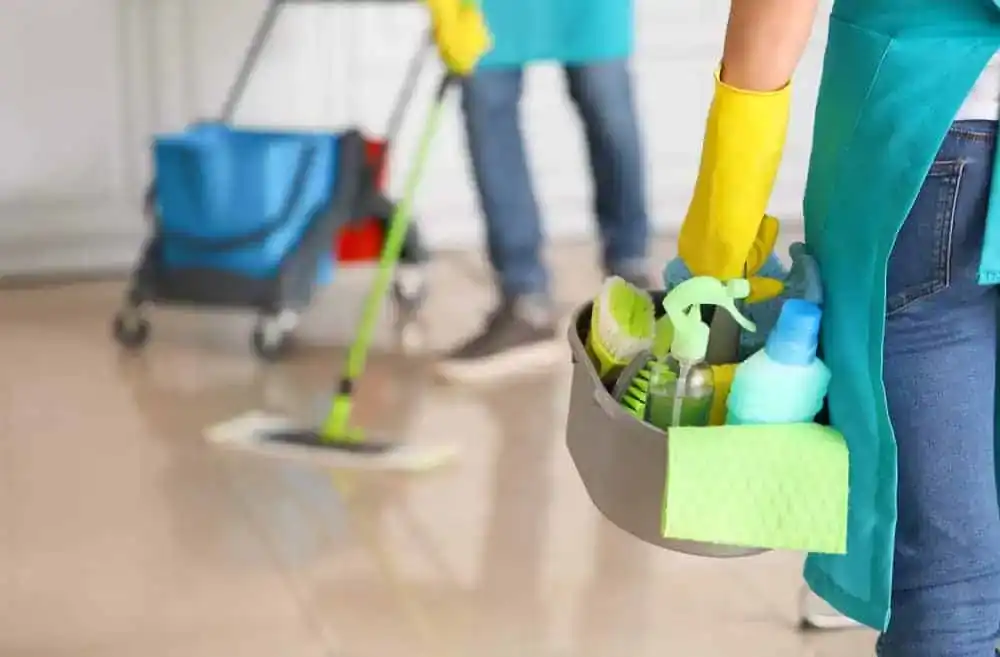
Post-construction cleaning addresses a completely different problem. The residue left behind after a renovation — drywall dust, grout haze, adhesive, construction debris, protective film — requires different equipment, different products, and a different process. HEPA-filtered vacuums are essential because standard vacuums don’t capture fine construction dust — they recirculate it, which means you end up with a room that looks clean but has airborne particles settling back down within hours. Microfiber cloths trap particles at the surface level rather than spreading them. Non-abrasive, non-toxic cleaning agents are critical for new finishes — the wrong product on a new quartz countertop or freshly installed hardwood can cause damage that’s expensive to fix.
This is also why DIY post-construction cleaning often falls short. It’s not that homeowners aren’t capable — it’s that most households don’t own HEPA-filtered equipment, and the instinct to wipe surfaces down with a conventional cloth or standard vacuum often makes the dust problem worse before it gets better.
For families in DuPage County with young children or pets, this matters beyond aesthetics. Drywall dust contains fine silica particles. Construction adhesives and sealants carry residual chemical compounds. Getting those out of the home before the space is occupied is a health consideration, not just a cleanliness one. We use non-toxic, eco-friendly cleaning products specifically because the stakes are higher after a renovation than after a regular cleaning day.
We’ve been doing this in Naperville and across DuPage County for over 15 years, and we carry an A+ rating from the Better Business Bureau to back it up. If something isn’t right, we come back within 24 hours and make it right — no charge.
Finding the Right Home Improvement Contractor in Naperville — and Finishing the Job Right
A great renovation starts with a great contractor. But it ends with a space that’s actually ready to live in — and that last part is on you to plan for, because most contractors won’t bring it up.
The good news is that it’s a straightforward problem to solve. Hire the right contractor for the build. Schedule the post-construction cleanup before you move back in. Use a cleaning team that understands what construction leaves behind and has the equipment to address it properly. That sequence — contractor, then cleaner — is how a renovation becomes a finished home.
If you’re wrapping up a project in Naperville or anywhere in DuPage County and you want a team that knows how to handle what comes after the contractor leaves, reach out to us at SparkMaids LLC. We offer free quotes, flexible scheduling, and a 24-hour guarantee that we’ll get it right.