
Summary:
If you’ve ever cleaned your carpet and then watched your toddler press their hands into it — or your dog settle in for a nap — you’ve probably had a passing thought: what did I just put in there? It’s a fair question. Carpets don’t get rinsed. Whatever you apply stays in the fibers, and that’s a different situation than wiping down a countertop. For families in DuPage County, IL dealing with muddy winters, pet accidents, and allergy season, the stakes around what goes into your carpet are real. Here’s what you actually need to know.
What's Actually in Your Carpet Cleaning Products
Before you can make a good decision about how to clean your carpet, it helps to understand what most conventional products actually contain. The marketing on the bottle usually says “deep clean” or “tough on stains” — but the ingredient list tells a more complicated story.
Perchloroethylene, commonly called Perc, shows up in a number of carpet cleaning products and dry-cleaning solutions. The EPA classifies it as a probable carcinogen, and exposure has been linked to liver, kidney, and lung damage, as well as neurological effects including memory and mood changes. Butoxy Ethanol — a solvent also found in paints and varnishes — appears in carpet shampoos and stain removers. So does Naphthalene, a compound derived from coal tar that you’d more commonly associate with mothballs.
Beyond the individual chemicals, many anionic surfactants used in carpet cleaners are rated “F” for human and environmental safety by the Environmental Working Group. And because carpets aren’t rinsed after cleaning, residue from these ingredients doesn’t go anywhere. It sits in the fibers. Which is exactly where your family spends time.
Natural Carpet Cleaning Methods That Actually Work
The good news is that you don’t need harsh chemistry to get real results on most everyday carpet issues. A few straightforward, non-toxic methods can handle a surprising amount — as long as you know how to use them correctly.
Baking soda is one of the most effective tools for carpet odors. Sprinkle a generous layer over the affected area, let it sit for several hours (overnight works better), and vacuum it up thoroughly. It absorbs odors rather than masking them, which is why it actually works where sprays often don’t.
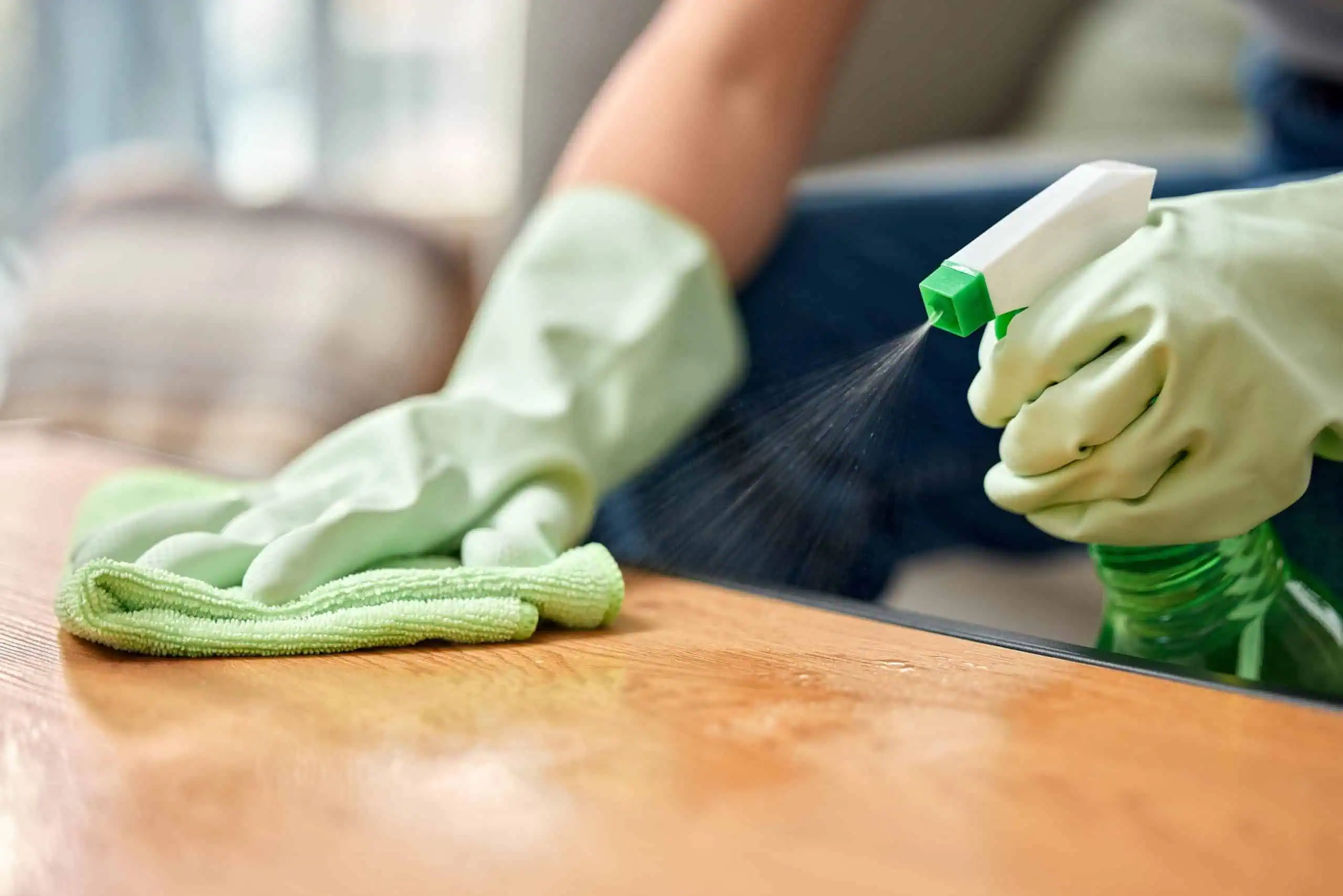
For stains, a 1:1 mixture of white vinegar and water applied to the spot and blotted — not scrubbed — handles a wide range of fresh marks without damaging fibers. The faint vinegar smell dissipates as it dries. For a light all-purpose clean, a solution of about a quarter cup of Castile soap per gallon of warm water, applied with a microfiber cloth and blotted dry, is safe for most carpet types and leaves no harmful residue behind. Club soda is worth keeping on hand for fresh spills — applied immediately and blotted, it can lift a stain before it sets.
The consistent principle across all of these methods is blotting, not scrubbing. Scrubbing pushes the stain deeper into the fibers and can damage the carpet structure. Work from the outside of the stain inward, apply light pressure, and give the solution time to do its job. Patience matters more than force.
These methods work well for surface-level soiling, fresh stains, and general deodorizing. They are not a substitute for deep cleaning. Allergens, dust mites, pet dander, and bacteria live in the lower layers of carpet fibers — not on the surface — and no DIY method reaches them effectively. That distinction matters, especially for households where allergies or asthma are a factor.
Green Carpet Cleaning: What It Actually Means
“Green carpet cleaning” has become a popular phrase, and like most popular phrases in the cleaning industry, it gets used loosely. A company can call itself eco-friendly without any third-party verification, without disclosing which products they use, and without any meaningful standard behind the claim. That’s worth knowing before you hire someone to clean the carpet your kids sit on.
Genuine green carpet cleaning involves a few specific things. It starts with certified products — not just products a company has decided to label as natural, but products that have been evaluated and certified by a recognized body. The Green Clean Institute is one such organization. Certification through them means the products have been assessed against documented standards for human and environmental safety. That’s a different level of accountability than a marketing claim on a website.
Equipment matters too. HEPA-filtered vacuums don’t just pick up surface debris — they capture fine particles including pet dander, dust mite waste, and pollen that standard vacuums recirculate back into the air. In DuPage County, where spring and fall pollen seasons hit hard and many households have both kids and pets, that distinction has real consequences for indoor air quality. Microfiber cloths, used correctly, trap fine particles rather than spreading them around — another detail that separates a thorough professional clean from a surface pass.
The method itself also plays a role. Low-moisture cleaning systems and hot water extraction done correctly remove contaminants from deep in the carpet without over-wetting the fibers. Over-wetting is one of the most common mistakes in carpet cleaning, professional or otherwise, and it creates conditions for mold and mildew to develop in the padding beneath. A company that understands green carpet cleaning will also understand the importance of not leaving your carpet soaking.
We’re certified by the Green Clean Institute — which means when we say eco-friendly, there’s a named certifying body behind it. We also use HEPA-filtered vacuums and professional-grade equipment, and we’ve been serving DuPage County for over 15 years. That combination — certified products, professional equipment, and local experience — is what separates a genuinely green clean from a label.
Want live answers?
Connect with a Spark Maids LLC expert for fast, friendly support.
Carpet Deep Cleaning: When DIY Isn't Enough
Regular vacuuming keeps surface debris under control. Natural spot treatments handle fresh stains. But neither of those things constitutes a deep clean, and the difference matters more than most people realize.
Your carpet functions like a filter — it traps dust, allergens, pet dander, pollen, and bacteria that would otherwise stay airborne in your home. That’s actually useful, up to a point. But like any filter, it has a capacity. Once it’s saturated, it stops trapping and starts redistributing. At that point, walking across the carpet stirs up more particulate than it contains.
In DuPage County, where winters mean months of road salt, wet boots, and tracked-in debris, carpets in high-traffic areas can reach that saturation point faster than most homeowners expect. By the time spring arrives, a thorough deep clean isn’t a luxury — it’s catching up on five months of accumulation.
How Often Should You Deep Clean Your Carpet?
The standard recommendation from most carpet manufacturers and cleaning professionals is a professional deep clean once or twice a year for the average household. But “average household” is doing a lot of work in that sentence, and most DuPage County homes don’t fit the average profile.
If you have children under five — especially crawling infants — the carpet they’re in contact with is a direct exposure surface. That changes the calculus. If you have pets, particularly dogs that go in and out through the yard, you’re dealing with a consistent cycle of tracked-in debris, pet dander, and occasional accidents. If anyone in the household has allergies or asthma, embedded allergens in carpet fibers are a real trigger, not a theoretical one. Any one of those factors is a reason to clean more frequently. Most DuPage County families are dealing with more than one.
The Illinois climate adds another layer. From November through March, DuPage County roads are treated with salt and sand. That material gets tracked in on boots and paws and works its way into carpet fibers where vacuuming can’t fully reach it.
A practical rule of thumb for most DuPage County households: plan for a professional deep clean in spring and again in fall, and address spot issues with natural methods in between. If you have pets or young children, lean toward the more frequent end. If anyone in the household has respiratory sensitivities, don’t wait for the carpet to look dirty — embedded allergens are invisible until they’re airborne.
Rental Machines vs. Professional Equipment
This is one of the most common questions we hear, and it deserves a straight answer: no, rental machines don’t do what professional equipment does. Rental carpet machines are consumer-grade equipment designed for occasional use. They have significantly less suction power and lower water temperature than professional units, which means two things. First, they don’t extract as much of what’s embedded in the carpet. Second, they leave more moisture behind — and moisture trapped in carpet padding is exactly the condition that leads to mold and mildew growth beneath the surface.
There’s also the residue question. Consumer carpet cleaning solutions, even the ones marketed as safe or natural, often leave a sticky film on carpet fibers. That residue attracts new soil, which is why carpets cleaned with rental machines sometimes look dirtier faster than carpets that weren’t cleaned at all. It’s a frustrating outcome when you’ve put in the time and effort.
Professional equipment — the kind we use at SparkMaids LLC — operates at a different level. Pro-Team commercial vacuums are built for sustained, high-performance extraction in ways that consumer models simply aren’t. Paired with HEPA filtration and certified non-toxic solutions, professional carpet cleaning removes what’s actually in the carpet rather than redistributing it or sealing it under a layer of residue.
That said, the goal here isn’t to talk you out of DIY maintenance. Baking soda, vinegar solutions, and regular vacuuming are genuinely useful for keeping carpets in good shape between professional cleanings. The point is to be clear about what each approach is actually capable of — so you’re making an informed decision rather than discovering the limits of a rental machine after the fact.
We’ve been serving DuPage County families for over 15 years, and we’re bonded, insured, and BBB Accredited with an A+ rating. Our neighbors on Nextdoor named us a Neighborhood Favorite in both 2022 and 2023. If you want a free quote, we’re available Monday through Saturday, 8am to 6pm, by phone or text at 331-320-5620.
The Bottom Line on Cleaning Carpet Safely
Keeping your carpet clean without exposing your family to harsh chemicals isn’t complicated — but it does require knowing which methods are actually effective and which claims are worth trusting. Natural approaches like baking soda, vinegar solutions, and Castile soap handle everyday maintenance well. For embedded allergens, deep-seated odors, and the kind of accumulation that builds up over a DuPage County winter, professional cleaning with certified green products and professional-grade equipment is the more honest answer.
The key is matching the method to the problem. You don’t need a professional for every spot. You do need one when the issue goes deeper than the surface — and in a household with kids, pets, or anyone with respiratory sensitivities, that point comes sooner than most people expect.
If you’re ready to schedule a deep clean or just want to ask a few questions first, we’re here for it. Reach out any time Monday through Saturday and we’ll get you a free quote — no pressure, no guesswork.